BSC team
Invalid username or password!

Invalid username or password!
Nitrogen Dioxide (NO₂) is a pollutant gas released in the air when fossil fuels are burned for transportation, heating, industry, energy production, etc. In cities, the main source of NO₂ is road traffic.
Furthermore, NO₂ reacts with other gasses to form other pollutants, such as ground-level ozone. The short and long-term exposition to NO₂ can cause or exacerbate health problems, which drives the need to analyze its levels. For example, NO₂ can cause irritation to airways and respiratory conditions or can be associated with cardiovascular issues.
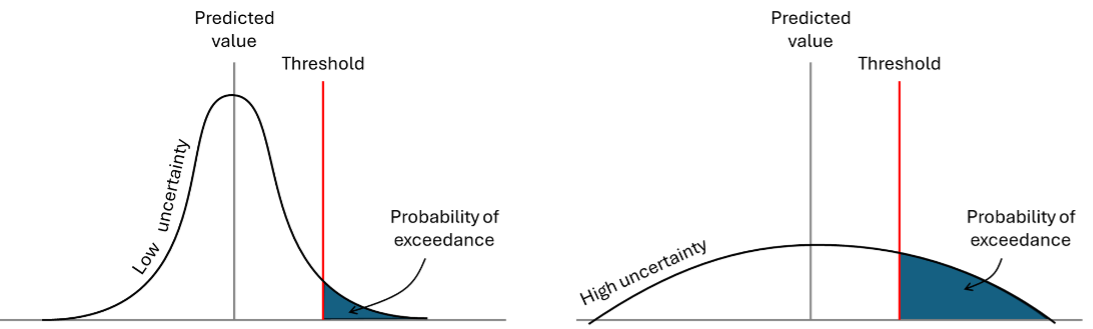
Uncertainty can be expressed as the statistical dispersion of a measurement or prediction, i.e., an interval above and below the real value.
The raw data from sensors, the air quality models and the interpolation method used to create the maps have limitations that are subject to various sources of error, i.e., uncertainties. Therefore, we cannot measure the exact value of an air pollutant concentration, or we cannot predict the NO₂ levels over the entire city without errors.
An exceedance is defined as the event in which a limit is outstripped. In the context of air quality, an exceedance occurs when the concentration of a pollutant exceeds the threshold value stipulated in the legislation or health recommendation.
The Probability of exceedance gives the likelihood of experiencing a hazardous concentration based on legislation or a recommendation. It is defined as the probability of occurrence of an event in which the concentration of a pollutant is higher than a specific limit. As it is a probability, can be expressed as a percentage, being 0% not likely to occur, and 100% very likely to occur. Calculating exceedance probability maps provides important risk information to governments, urban planners, social agents and communities.
Directives 2008/50/EC and 2024/2881 of the European Parliament and of the Council on ambient air quality and cleaner air for Europe set air quality objectives designed to prevent or reduce the harmful effects of air pollution on human health and the environment. Directive 2024/2881, published in 2024, sets stricter limits on ambient air pollution than Directive 2008/50/EC.
Additionally, the World Health Organization (WHO) sets the 2021 Air Quality Guidelines. Although these are not legally binding limits, they provide evidence-based recommendations of limit values for air pollutants to protect human health.
The following table summarizes NO₂ concentration thresholds established by Directives 2008/50/EC and 2024/2881 and the WHO Air Quality Guidelines:
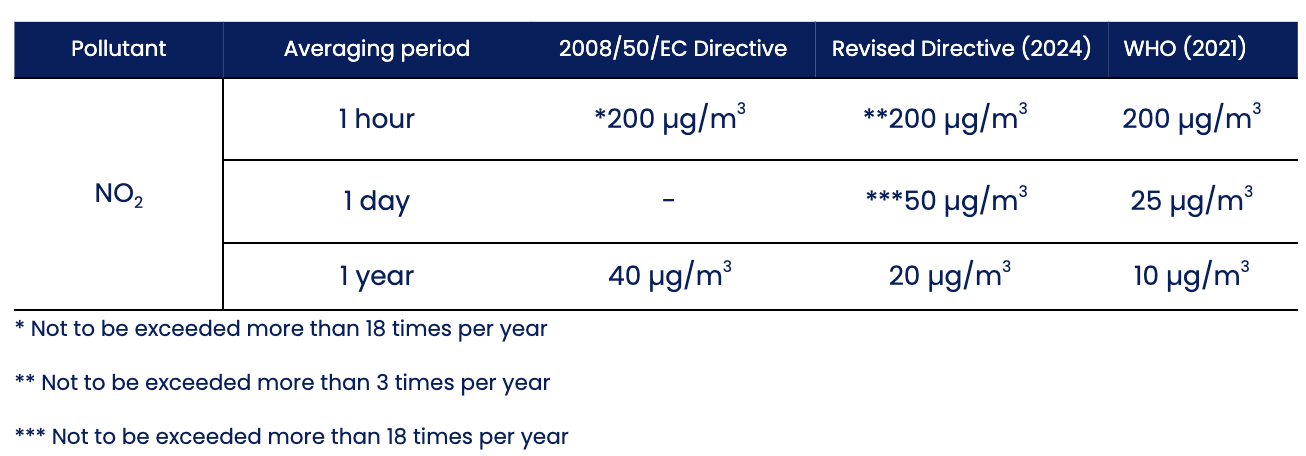
Regarding exceedance probability values, please note that this website allows users to visualize exceedance probability maps of the annual limit values set by Directives 2008/50/EC (40 µg/m³, in force at the time) and 2024/2881 (20 µg/m³), as well as the 2021 WHO guidelines (10 µg/m³), in the 'Map Dashboard: Map Configuration' section. Additionally, the 'Map Dashboard: Data Download' section enables users to download exceedance probability maps for those annual thresholds, as well as daily exceedance values based on the daily limits set by Directive 2024/2881 (50 µg/m³) and the 2021 WHO guidelines (25 µg/m³).
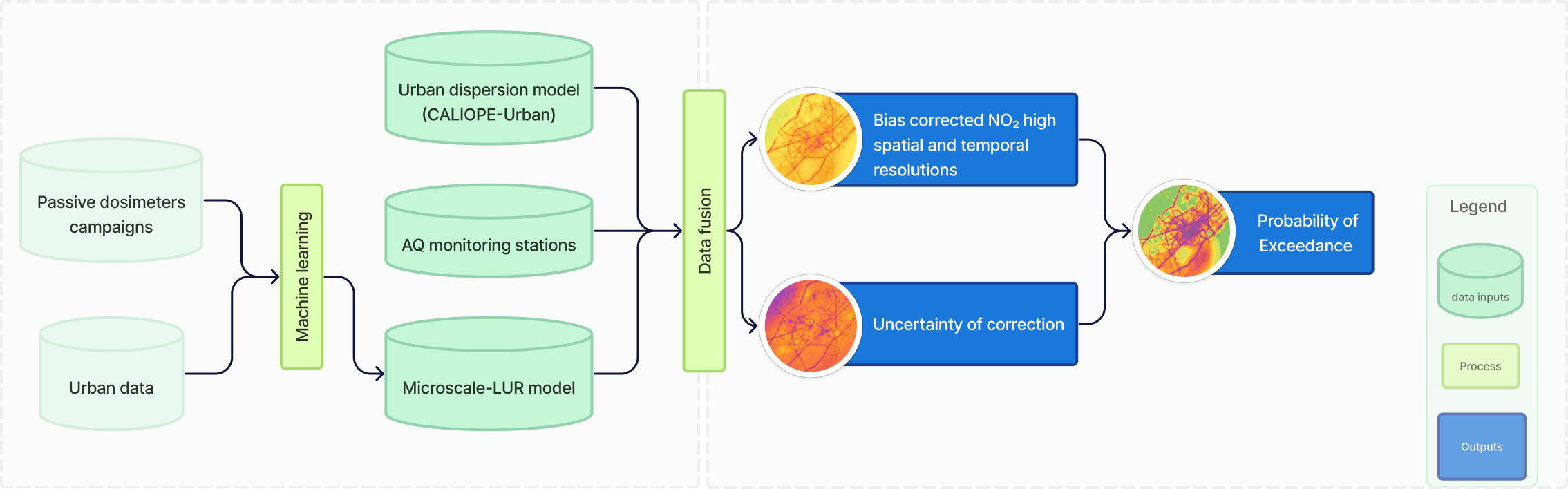
Hourly high-resolution concentrations of surface NO₂ at the street scale over the city of Barcelona are estimated using the CALIOPE-Urban multiscale air quality model (Benavides et al., 2019). At the regional scale, CALIOPE-Urban relies on the regional air quality modeling system CALIOPE (Baldasano Recio et al., 2011) for predicting the urban background NO₂ concentration.
The data-fusion method combines (Criado et al., 2023):
Besides the bias corrected NO₂ hourly maps, the data-fusion method also computes the uncertainty associated to the variance of the estimated error during the correction process. By integrating corrected NO₂ values and their associated uncertainty, we are able to map over Barcelona the probability of exceeding any concentration limit, such as the hourly, daily, or annual thresholds set by the Air Quality Directive or the corresponding WHO guideline limits.
For more information about the methodology, such as the calculation of uncertainty or previous statistical results, please refer to Criado et al. (2023).
In case of using the contents of this website, kindly inform us via mail alvaro.criado@bsc.es
Please check the platform version with its respective release date (About the app : Version)
Variables (NO₂, Uncertainty, Probability of exceedance):
Layers:

Álvaro Criado (alvaro.criado@bsc.es), Antonia Frangeskou (antonia.frangeskou@bsc.es)
Firstly please check the References section